
Outcomes-based regulation is always a statement of intent, regardless of sector. It signals change, big transformation and – more often than not – a collective desire for cultural progression after significant failures have come to light.
The new Competence and Conduct Standard for social housing is indicative of this.
Born from discourse of unprofessional standards, the Grenfell Tower Inquiry, the tragic death of Awaab Ishak, evidence of breakdowns of trust, reports of sub-standard service, and significant competence and behavioural issues within the sector, the Regulator of Social Housing (RSH) has set an ambitious agenda for professional reform.
When regulators introduce new requirements and expectations, they often come with a collection of statements of intent that signal firms need to get on board. Multiple calls for input, consultations, thematic reviews, guidance, papers and speeches for firms to interpret.
Outcomes-based regulation adds another layer of complexity to this, as it puts the onus squarely on individual organisations to demonstrate how they’re adopting, embedding, complying and evidencing that they’re taking the regulation seriously.
And this is where a “fork in the road” moment often occurs for many firms.
At the heart of most regulatory change, regulators unconsciously ask firms to consider simple questions: “What are you going to do differently now?” “What’s changing?” “How will you know if you’re succeeding?” “Can you show us the evidence?”
This raises an important consideration: Do you continue to do as you’ve always done, or do you adopt different ways of operating?
It’s a great question for us to consider, because one thing is certainly clear: the RSH is expecting to see demonstrable culture change in practice.
They’ve invested in the regulation, it’s government-backed, it impacts a significant proportion of the UK’s population and will likely be a regular feature for most press publications as the enforcement date draws nearer. It’s going to be a part of the social consciousness and may well put associations under the microscope for greater regulatory scrutiny.
Granted, there is a lengthy period for associations to get their own houses in order to comply with the Standard, but it’s a wise move not to get too complacent about the scope of the project in play.
Like any change management initiative, it takes time, it takes effort and, most importantly, it takes a genuine willingness to look beyond ticking boxes.
At this early juncture, it’s wise to pay heed to this infamous quote: “The definition of insanity is doing the same thing over and over again and expecting different results.” If this resonates with you, you’re likely on board with the RSH’s statement of intent: “culture change is necessary.”
“The standard will play a pivotal role in the wider work taking place across government to improve the quality of social housing, and it is an important step in professionalising the sector. It will drive the culture change necessary to eradicate unprofessional attitudes and stigma. The new standard achieves this by introducing clear requirements around the systems and processes that social landlords must have in place to ensure that their staff have the appropriate skills, knowledge and experience required to provide high quality and respectful services to all tenants.”
Source: GOV.UK | Competence and Conduct Standard for social housing: government response
Looking at the Competence and Conduct Standard pragmatically, we can say that there are two distinct workstreams in play. Arguably, the easier of the two workstreams is the formal qualification component for senior management and executives.
The harder component relates to the wider competence and cultural evidence piece of the Standard.
Make no mistake, culture change is a significant transformation project. Research from Deloitte, for example, estimates that culture change can take anywhere between three and five years to execute successfully. So, it’s probably no coincidence that the RSH has given associations such a lengthy preparation and transition period.
The social housing sector can also learn important lessons on cultural transformation agendas from other regulators – and the challenges firms have in implementing them.
We’re three years in since the Financial Conduct Authority’s (FCA) flagship piece of regulation – the Consumer Duty – came into force.
The FCA has expressed a sentiment that they’re seeing improvements, but the regulator also recognises that, collectively, there is more to do to raise the cultural bar.
To give you an idea of just how challenging cultural transformation is when pitched against an outcomes-based regulation, in January 2026, we conducted a sentiment check of 720 senior financial services professionals and asked them how they are currently evidencing a strong Consumer Duty culture in their firm.
- Just 8% of respondents said that they could clearly evidence that their culture drives day-to-day decision-making and customer outcomes in practice.
- 35% said their culture exists on paper but doesn’t shape day-to-day decision making.
- 33% said that senior leadership still hadn’t clearly articulated what “good outcomes” actually look like in practice.
From the outset – much like the RSH – the FCA has made it crystal clear to firms that positive cultural change is the foundation of the Duty. It serves as the underpinning mechanism for how firms can drive up consumer trust in products, markets, outcomes, service, and the sector as a whole.
It’s been positioned as priority regulation to help to shape and support a truly customer-centric culture in practice across the sector; one that continually prioritises good customer outcomes, consumer experience, day-to-day decision making of staff, fair value and appropriate support and communication.
Again, like the Standard, competence under the Duty is not seen as being achieved through a ‘once-and-done’, tick-box mindset. In the eyes of the FCA, it’s continuous, it’s adaptive, it’s reflective. It’s personalised.
It’s less about generic e-learning courses, certificates that get stored away in folders, training hours recorded and rates of training completion. It’s about affected and demonstrable change in the way firms operate and specifically how competence correlates to good cultures, sound conduct, and the outcomes for the customers they serve in terms of the products they purchase and the standard of advice and service they receive.
The competence outcome isn’t about ‘training’. Training is an input; the output is what is important.
Competence is about having robust systems and processes in place to consistently define, measure, assess, improve and evidence whether your people are competent as a result of what they have been taught.
Yet, the latter observation continues to be one of the most overlooked component parts of the learning and development process. The ironic thing about this is that most organisations know it’s a big problem.
GOV.UK’s Employer Skills Survey (ESS) is a key source of intelligence for understanding the skills challenges faced by employers, both within their existing workforce and when recruiting. The survey gives insights into how they respond to these challenges through investment in training and workforce development. Over 22,000 UK employers participated in the ESS in 2024.
The study found that 78% of all employee knowledge, competence and skill gaps are caused by transient factors (i.e., the passing of time).
Simply put: When employees don’t complete their training, employers fail to follow up on training they’ve conducted, or when they don’t support new colleagues with the necessary investment when onboarding, staff quickly forget what they need to know.
The 2024 ESS report also concluded that – in what appears to be part of a long-term pattern of declining training provision and investment – the proportion of employers providing any training to their employees fell to its lowest level in the ESS series to date.
This should be a major concern, because the way organisations invest and support workforce competence development also reflects how culture operates in practice.
And, again, this comes back to the ‘fork in the road’ moment.
Most of our Clever Nelly deployments – though they may relate to a specific deployment usage, i.e. compliance, risk, or performance (KPI improvements) – all tend to have one thing in common: our customers come to us because there is an organisational change imperative that needs attention, due care and focus.
There is a recognition that something needs to be done differently to achieve a specific outcome.
They recognise that their workforce requires continual help and support to understand and embed the change. It requires employee engagement and buy-in; it requires top-down leadership to drive it, and a ‘change signal’ that makes staff sit up and take notice that this particular initiative is of critical importance to the continued successful operation of the business.
Across multiple case studies we’ve conducted with our customers, we’ve found that there is also one common – yet very simple – factor that drives improvement: engagement.
Regardless of whether the focus of the Clever Nelly deployment is to reduce employee errors, improve competence against a particular KPI, or manage an element of operational risk, engagement is always the single biggest success characteristic.
It sounds obvious – but it makes sense.
When organisations begin to think about competence as a measurable KPI; one that is just as important as any other critical datapoint within their business, it becomes tangible, trackable, fixable and demonstrable.
As the business management expert, Peter Drucker, once said: “You can’t manage what you don’t measure.”
The key thing to remember is that competence management needs to be a built-in process within BAU, not simply bolted on.
Measure it, manage it, evidence it. This is what we help regulated organisations to do daily. So, if you’re looking at how you can be a leader in the sector and get ahead of the curve, please get in touch – I’d be happy to show you how it can be achieved with our multi-award-winning technology: Clever Nelly.
Thanks for reading,
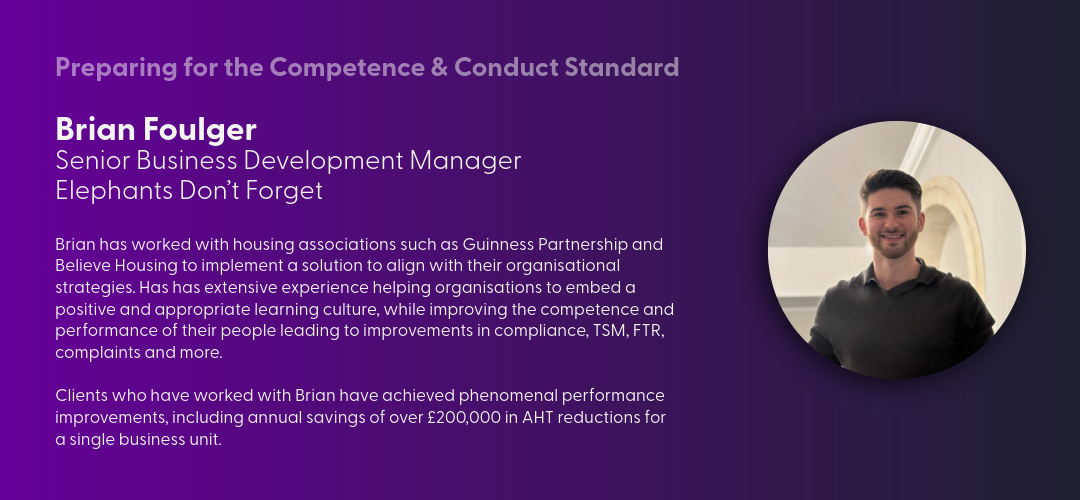
Brian Foulger
Further resources
- You can contact Brian via email: brian@elephantsdontforget.com
- Alternatively, if you would like to request a free consultation to discuss how our technology is supporting housing providers to improve their organisational strategies from a compliance, risk, and performance perspective, please click here.
- Access our free e-guide: Preparing for the new Competence & Conduct Standard: Culture, Systems & Evidence. In this paper, we look at how providers can prepare their workforce for the new standard and offer six recommended steps to begin your planning.