The Regulator of Social Housing (RSH) is adopting an assurance-based approach, consistent with its other consumer standards. This requires providers to demonstrate that they are meeting the standard in a practical way, rather than simply possessing documentation.
A focus on efficacy and outcomes
A prescriptive list of required skills or behaviours is not anticipated from the RSH. Instead, organisations will be expected to define what constitutes competence and conduct for their specific employees and services. The Regulator’s focus will be on the efficacy of your systems, the quality of your evidence, and the outcomes you achieve, rather than on individual certificates of learning.
Organisations will be required to assess their own workforce, identify all roles that are in scope, and show how they are actively managing and closing any identified gaps. As the first point of contact for the Regulator, boards, committees, and governance teams must be fully prepared with the necessary information to prove compliance.
Examples of evidence for regulatory review
When the Regulator requests proof of compliance, they may look for:
- Comprehensive records: Detailing staff training needs, qualifications, and specific plans to address any competence gaps.
- Tangible proof of impact: Evidence of the positive impact of training and development – such as improvements in service delivery – rather than just training attendance logs.
- Customer feedback data: Including complaints, compliments, and satisfaction scores that demonstrate how service quality is experienced by residents.
- Customer involvement: Evidence showing that your organisation has actively involved customers in defining standards of good conduct and professionalism.
- Code of Conduct: A well-established code with demonstrable proof that employees understand and follow it.
- Professional standards: Records of relevant professional body memberships and a clear framework for ongoing Continuing Professional Development (CPD).
- People strategy: A transparent strategy outlining learning and development, performance appraisals, and performance management processes.
How to prepare for October 2026
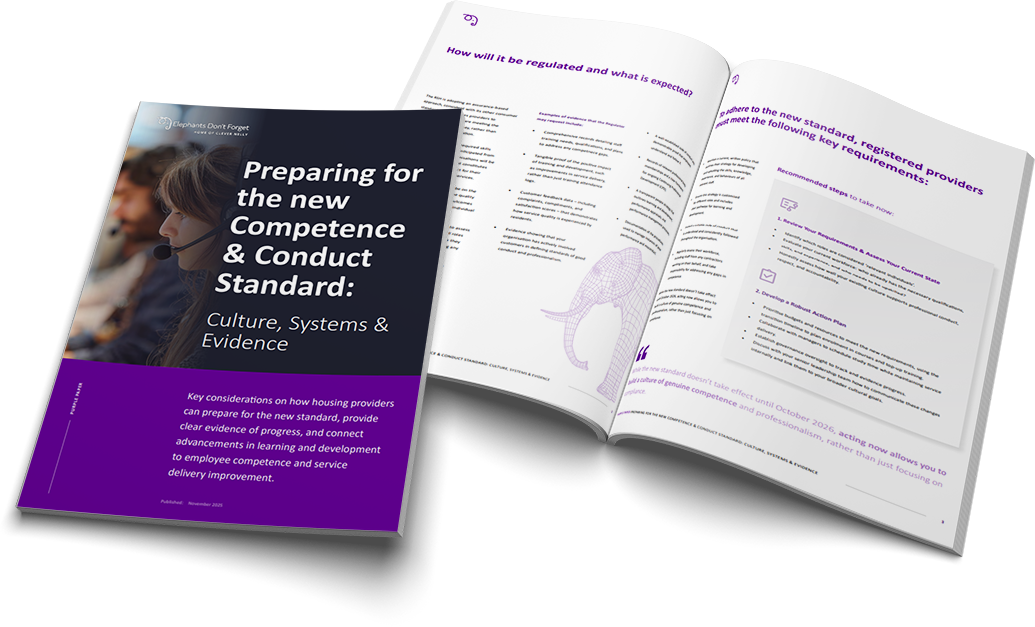
Our e-guide offers a comprehensive review of the recommended steps to take to prepare for the new Competence and Conduct Standard, which takes effect in October 2026. It is a helpful resource for C-suite executives and senior leaders working in customer service, operations, compliance, risk, HR, and neighbourhoods.
Within the guide, we discuss how providers can:
- Improve staff training and record-keeping: Learn how to continally improve and evidence how you are closing identified gaps in knowledge and competence.
- Demonstrate impact on KPIs: Connect training and development to resident-facing metrics, including Tenant Satisfaction Measures (TSMs), complaint reduction, and “First Time Right” delivery.
- Embed and evidence conduct: Continually assess and demonstrate that staff understand your code of conduct while providing best-in-class regulatory evidence of compliance.
Access the guide here
Further resources
- To learn more about how we’re supporting providers, contact our Housing SME and Senior Business Development Manager, Brian Foulger: brian@elephantsdontforget.com
- Alternatively, if you would like to request a free consultation to discuss how our technology is supporting housing providers to improve their organisational strategies from a compliance, risk, and performance perspective, please click here.