
We were delighted to attend the National Housing Federation’s Customer Experience & Resident Engagement Event on Tuesday 24 February 2026.
Headed up by our housing SME and Senior Business Development Manager, Brian Foulger, alongside our Account Manager, Joe Breckenridge, our team was also joined by Sue Holte-Smith from The Guinness Partnership to share their insights into how social housing associations are using our multi-award-winning AI, Clever Nelly, to embed and evidence employee knowledge and competence to the highest regulatory standards within the sector.
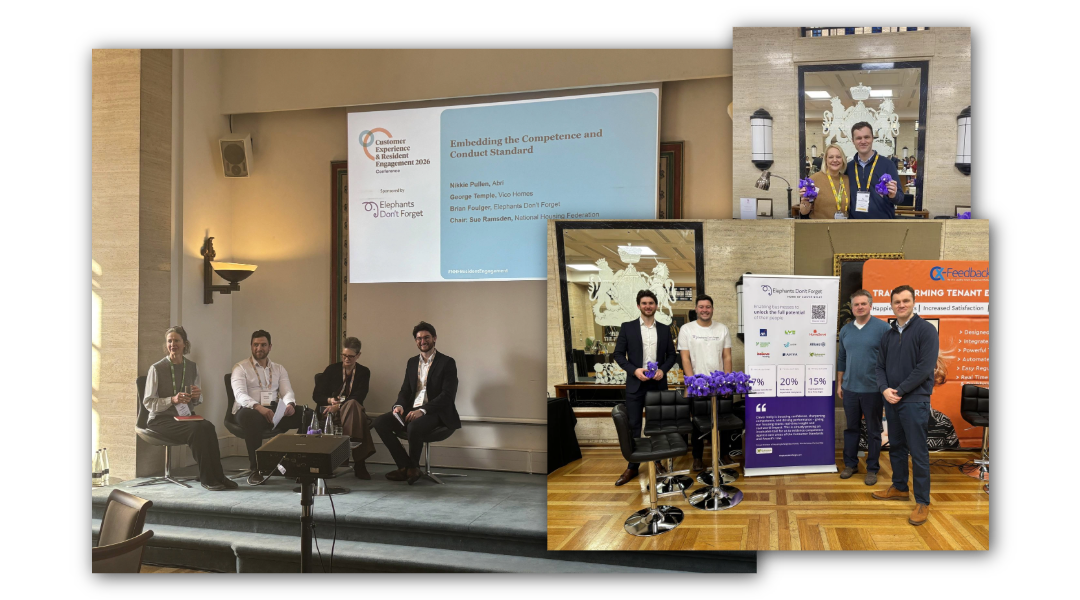
Brian was a guest panellist for a session exploring how providers were planning to execute the successful embedding of the new Competence and Conduct Standard, effective October 2026.
Reflecting on the supporting work Elephants Don’t Forget have conducted with our customers in the sector, including The Guinness Partnership and Believe Housing, he shared insight as to how our technology is supporting providers to improve their organisational strategies from a compliance, risk, and performance perspective – helping them to embed and evidence an appropriate learning culture, whilst improving the competence and performance of their people.
With the RSH adopting an outcomes-based approach and looking for demonstrable evidence that training and development activities directly translate into measurable improvements in staff competence, service delivery, organisational culture, and positive resident outcomes, Brian’s session involved exploring how we are supporting providers to prepare, solve common compliance challenges, improve key operational metrics, and provide associations with the new data, MI, and evidence required to demonstrate they have robust systems and processes in place to meet the new regulatory expectations and support them with their planning and transition period.
Reflecting on the day, Brian said:
“It was an extremely insightful day with some interesting talks and panel discussions throughout, involving a mix of housing association staff and residents. I was delighted to be invited to speak on a panel regarding the embedding of the Competence and Conduct Standard. My key takeaway is that housing associations must move away from a tick-box approach to legislation in favour of a positive and appropriate culture. Ultimately, embedding change comes down to your people; empowered frontline colleagues are the ones who prevent escalations and improve the resident experience. Trust is built in everyday interactions with residents, and associations must provide the right internal culture to drive that behaviour.”
Joe spent time attending other sessions available and talking with providers. Here were some stand-out reflections:
- Strain on frontline staff – resilience and wellbeing
A major theme was the growing pressure on frontline teams. They are managing increasingly complex caseloads and high demand, and in many cases are subject to verbal abuse or challenging behaviour from residents. This is having a real impact on wellbeing and mental health.
A statistic shared suggested around one in five staff are now taking time off due to mental health-related reasons, which is putting further strain on the sector. As a result, housing associations are placing much greater emphasis on resilience, respect, and retention.
Many are investing in:
- Psychological resilience training
- Empathy and communication training
- EDI training
- Broader wellbeing support initiatives
The aim is not just to support frontline teams, but colleagues at all levels, equipping them with the tools to manage pressure and better support residents.
- Awaab’s Law – greater accountability and proactive responsibility
Joe attended a session on Awaab’s Law, which included input from a representative of the Housing Ombudsman. There is significantly more emphasis on accountability, particularly around damp and mould:
- Phase 1 focuses on how housing associations respond when damp and mould are reported — escalation processes, remediation timelines, and ensuring issues are resolved properly.
- Phase 2 looks at root cause analysis — ventilation, structural issues, maintenance failures (e.g., blocked gutters), and other contributing factors.
Importantly, attributing damp and mould to “resident lifestyle” is no longer considered an acceptable response. There is a clear expectation that housing associations take proactive responsibility and investigate underlying causes thoroughly. This places additional operational and reputational pressure on organisations and, by extension, on frontline teams.
- Communication, empathy, and safeguarding
Across multiple sessions, communication came up repeatedly. There’s a strong push for housing associations, and in particular frontline teams, to:
- Improve how they communicate with residents.
- Increase empathy and understanding.
- Work more collaboratively to resolve issues.
- Be more aware of safeguarding concerns, domestic abuse, and health and safety risks.
Overall, the sector feels under significant financial and regulatory pressure, with heightened scrutiny and expectations. That responsibility ultimately flows through to operational teams, particularly those working directly with residents.
Further resources
What our customers say…
“Clever Nelly is boosting confidence, sharpening competence, and driving performance – giving our housing teams real-time insight and real-world impact. This is already proving an invaluable tool for us to evidence competence against core areas of the Consumer Standards and Awaab’s Law.”
Sarah Sargent, Group Director of Housing & Neighbourhoods, The Guinness Partnership

Download E-guide
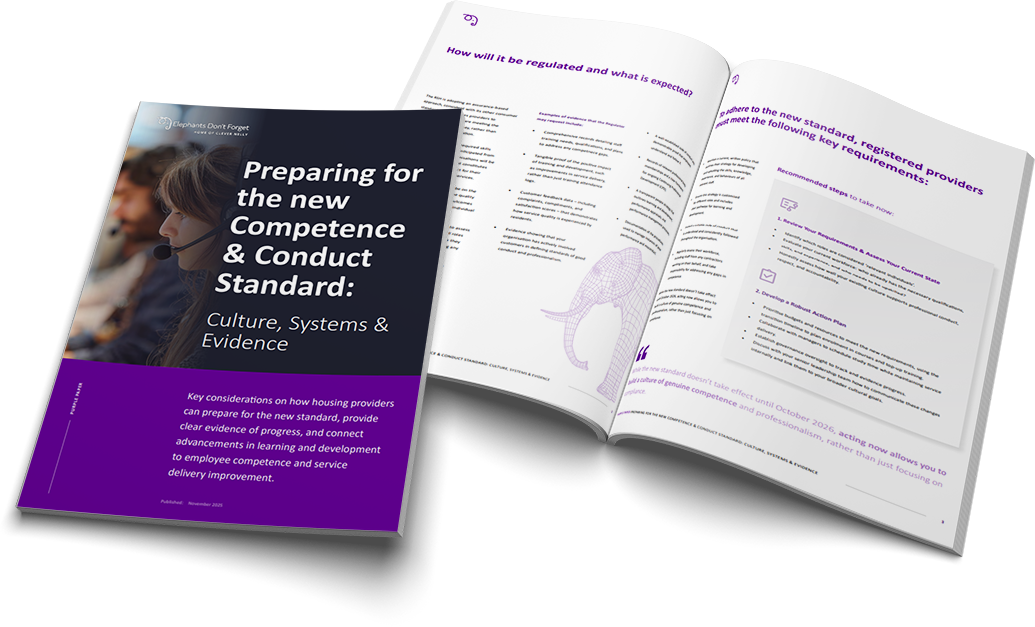
In our latest guide, we offer a comprehensive review of the steps required to prepare for the new Standard. It serves as a vital resource for C-suite executives and senior leaders across various functions, including:
- Customer Service and Operations
- Compliance and Risk
- HR and Learning & Development (L&D)
- Housing and Neighbourhood Management
Key Themes Explored:
- The “Need-to-Know” Changes: How the new requirements could impact your day-to-day operations.
- Regulatory Expectations: How the Standard will likely be regulated and the specific types of evidence required for compliance.
- Roadmap to Readiness: Six recommended steps your organisation should take now to ensure a smooth transition.