
According to the 2026 UK Customer Experience Decision-Makers’ Guide from ContactBabel, first-time resolution (commonly referred to as First Contact Resolution or FCR) remains the most important customer experience outcome. And yet the operating conditions frontline teams are working within are becoming significantly more demanding. The data points to a growing gap between what customers expect, what AI can reliably deliver, and what frontline agents are being asked to absorb under pressure.
FCR is still the single most important CX outcome
ContactBabel’s consumer research, conducted with 1,000 UK customers, shows that:
- 54% of customers ranked First Contact Resolution as the most important factor affecting their experience.
- A further 37% placed it in their top three, making FCR the highest-ranked CX factor on record.
- Short wait times (51%) and polite, friendly employees (49%) followed closely behind, reinforcing that resolution quality and human interaction remain central to customer satisfaction.
For contact centre and operational leaders, improving FCR is essential to keeping customers satisfied and preventing repeat contacts that add further strain to already pressured teams.
Channels aren’t being replaced, they’re being layered
One of the clearest findings in ContactBabel’s research is that customer service channels are being augmented rather than substituted, as seen in the chart below:
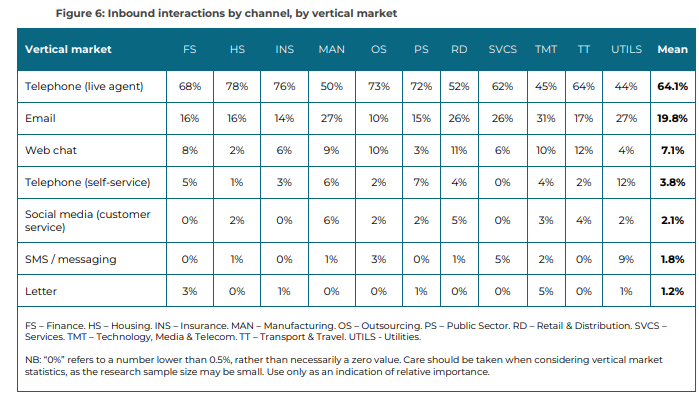
- Agent-handled calls remain the most important channel in housing and insurance.
- Telephony self-service is strongest in utilities.
- Public sector use of self-service is higher than usual.
Rather than simplifying operations, this creates a requirement for:
- unified customer context across channels.
- consistent resolution regardless of entry point.
ContactBabel notes that the pressure to unify the customer view across channels ‘is not going to go away’. For frontline teams, this means more cognitive load per interaction, particularly when customers arrive mid-journey.
AI is faster, but customers trust humans with accuracy and resolution
ContactBabel’s customer panel data shows a clear distinction between speed and quality when it comes to AI-enabled service. Customers reported that compared to live agents:
- 69% felt AI understood their issue less well.
- 59% said overall resolution was worse.
- 54% believed the accuracy of information was lower.
- 46% felt friendliness and tone were inferior.
While customers are willing to use AI for simple, transactional queries, there was little belief that AI is better for:
- Following up on ongoing issues.
- Complex or emotionally charged situations.
The implication is not that AI reduces demand, but that failed AI interactions often re-enter the system as more complex, higher-pressure contacts for human agents.
Customer concern amplifies frontline pressure
Research also highlights widespread customer anxiety about how AI is being deployed:
- 78% of customers are concerned AI may make it harder to reach a live agent.
- 67% are concerned about job losses in customer service.
- Around two-thirds worry about reduced empathy and understanding.
- At least 60% express concerns around data security or hidden AI use.
These concerns are based on lived experience with self-service, including failures to understand context or natural language. As ContactBabel notes, this is an industry-wide challenge, not one organisations can solve alone. When AI underperforms, customers escalate, and they arrive with lower patience and higher expectations of the human agent.
Where FCR quietly breaks down
ContactBabel’s findings point to a consistent pattern: customers still value fast, accurate, human resolution, yet AI currently delivers speed better than understanding or accuracy, while channels add complexity rather than remove it. As a result, live agents are increasingly left to handle the most difficult interactions, often mid-journey, emotionally charged and time-pressured.
Under these conditions, maintaining accuracy, empathy and consistency becomes harder to sustain. Elephants Don’t Forget’s own learning data shows that, without reinforcement, frontline teams typically retain only around 54% of their training over time. When demand rises and leaders are stretched, coaching and refresher activity is often deprioritised, leaving agents to rely on fading knowledge and judgement under pressure.
Over time, this erosion of in-role competence is what causes FCR to quietly break down. Resolution takes longer, customers re-enter the system, repeat demand increases and pressure compounds. In highly regulated environments such as financial services, this also introduces risk, including inconsistent decisions, reduced accuracy and uneven customer outcomes, all of which sit at the heart of Consumer Duty expectations.
The question for leaders, then, is how to protect performance and judgement when pressure is highest, without adding yet another layer of process or burden to already stretched teams.
How continual learning protects performance under pressure
Our e-guide draws on insights from a recent webinar panel discussion with Bupa Global and leading UK contact centre voice Martin Teasdale (Get Out of Wrap). It explores how leaders can support their people to maintain competence through continual, in-the-flow learning, closing knowledge gaps without taking agents off the floor.
The guide shows how confident, capable teams are better equipped to handle high-pressure interactions and deliver the quality conversations that protect First Contact Resolution, the core metric customers continue to value most in 2026.